Cubic-Inch Fee Calculation for Pottery Studio Firing
Pottery studios can charge fairly for kiln space using a simple volume formula.
Sponsored by Kilnbook
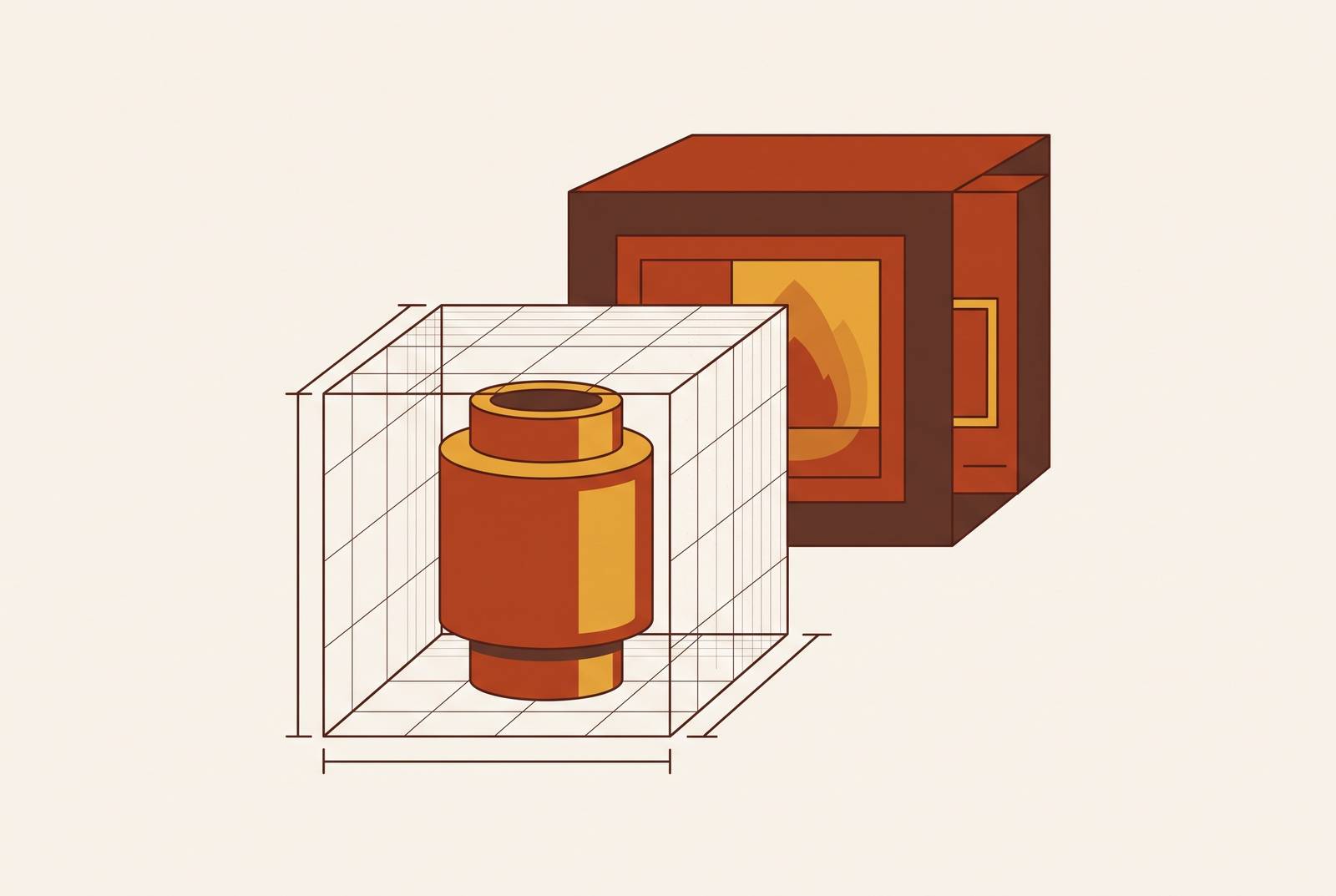
Cubic-inch fee calculation gives pottery studios a defensible way to charge for kiln space. The arithmetic is simple. Making it work requires a rate grounded in real costs, clear rules about what gets measured, and records that keep pace with the firing queue. A calculator can price a bowl, but it cannot run the kiln room.
Why charging for kiln space is genuinely hard to get right
Every studio firing members’ or students’ work faces the same awkward question. How much of the kiln’s cost belongs to this particular piece? A flat price per piece or firing session is easy to explain, but a tall vase and a salad bowl occupy different amounts of space. Charging the same for both makes the bills easy to work out, but it may be unfair.
Weight-based pricing gets closer to reflecting the actual kiln load, but named studios with formal weight-based rates are not well documented in practice. It exists more clearly as a concept than as a deployed standard. Electricity, element wear, loading and unloading labor, kiln wash, and kiln furniture are recurring costs. Those costs must land somewhere, even when no single measure divides them perfectly.
How the cubic-inch formula actually works
The cubic-inch method turns three dimensions into a billable volume. Width × depth × height = cubic inches. Cubic inches × rate = fee. For round pieces such as bowls, mugs, and vases, diameter fills both the width and depth fields, so it appears twice in the multiplication. This measures the rectangular space around the work.
Gailanna Pottery shows how this works with a mug measuring 4 × 3 × 5 = 60 cubic inches. Its fee for both bisque and glaze firing comes to $3.60. Measurement happens at the greenware stage, before any firing, when the piece is at its largest. That timing also puts the fee on record before the work enters the queue.
To make those measurements easier, Gailanna uses a physical “firing fee box” made from three foam poster boards taped into a three-sided grid. Each inch is labeled, with bolder lines at 5-inch increments. A kiln shelf outline on the base lets artists check their work against the actual shelf dimensions. A triplicate carbon-copy ticket then records the artist’s name, dimensions, and piece description. One copy travels with the work, one goes to the artist, and one stays in the book.
Photo Pottery offers a digital firing fee calculator for the arithmetic. Users enter height, width, and depth, set a per-cubic-inch or per-square-inch rate, and include any fixed add-ons for handles or attachments. The fee calculates instantly. For higher-volume or contract work, some studios instead bill in cubic feet. The Potters’ Studio prices its electric and gas firing services that way and states its measurement formula as “width × length × height + 2"”, making the local measurement rule part of the calculation.
What a per-cubic-inch rate is actually covering, and how studios set one
The rate compresses a studio’s firing costs into a charge for occupied space. Gailanna builds its rate from firing electricity, kiln maintenance and replacement, space costs, loading and unloading labor, and glazes, averaged per firing and per kiln across a year. Marin Pottery names loading and unloading labor, commercial electricity costs, and kiln maintenance. The electricity bill is only the beginning. Heating elements degrade with use, so each firing also draws against a future replacement budget.
That cost base explains why another studio’s rate is not a ready-made answer. A published number may pay for one firing, both bisque and glaze, or a wider bundle that includes studio glazes. Electricity also costs more in some places than others, and rates for members may serve a different purpose from rates for outside contract work. The units can match while the services do not. Comparing the numbers without their inclusions is like comparing lunch prices without checking whether one includes lunch.
Brooklyn Clay Industries makes those distinctions visible in its pricing. It offers a lower rate for collective firing covering one firing, charges $0.09/cubic inch for BCi glaze plus two firings, and charges more for BCi clay, glaze, and two firings. Marin uses a low per-cubic-inch member rate. The Potters’ Studio charges by the cubic foot, with rates that depend on membership and the type of firing and are higher for non-members and high-temperature gas firing.
For a studio setting its first rate, the lesson is to start with its own annual firing costs and divide them by the total cubic inches fired across the year. The calculation must reflect what the fee is meant to include, especially whether it covers one firing or two and whether glazes belong in the bundle. A peer’s rate is useful context only after those differences are understood.
How membership structure changes what the cubic-inch rate needs to do
An unbundled fee has the heaviest job. When every piece is measured and charged separately, with no flat fee subsidizing firing, the rate must cover the full firing cost. Brooklyn uses this model for non-members, with a minimum charge for one piece and rounding rules to the nearest increment.
A bundled-with-cap model shifts part of that job to membership. The monthly fee includes firing up to a stated cubic-inch threshold, and the volume rate applies only above it. Casual members gain protection from surprise bills, while high-volume makers still incur extra charges. This approach allows a lower headline overage rate because most members will not exceed the cap. It also provides more predictable base revenue, but only if monthly volume is tracked accurately.
Member discounts offer another way to divide the cost. The Potters’ Studio charges active members much less per cubic foot than contract firers for every type of firing, so the money saved on firing is one reason to join. Gasworks NYC takes a different approach to access. It keeps one per-cubic-inch firing rate across membership tiers and places its equity mechanism in the membership fee instead.
These choices also affect who a bundled arrangement can support. Studios that say membership is not intended for production potters use that rule to protect kiln capacity as well as to name whom membership is for. High-volume makers can overwhelm a queue and upset the economics of a package designed for casual use. An included firing allowance is still a claim on finite kiln space.
The shape problem: why wide bowls cost more than tall cylinders at the same rate
A bounding box is not a clay-weight measurement. Because the formula multiplies width, depth, and height, a wide shallow bowl can produce a larger billable volume than a tall narrow cylinder made with comparable clay weight. Width therefore has a big effect on the result, even when the piece looks small beside something taller.
That asymmetry has a physical basis in the kiln. A wide bowl takes a larger shelf footprint and cannot be packed under or inside other work in the same way a narrow cylinder can. The studio sees occupied shelf space. The potter may see a piece made with less clay and reasonably wonder why it costs more. Both are looking at the same bowl, but they are counting different things.
The lesson for studios is to explain this before the first firing bill. As a consequence of the model, potters making mostly bowls will pay more per piece than those making mostly mugs and cylinders at the same volume rate. Shape also affects revenue forecasting. A load of wide platters and shallow bowls can bring in more in fees than mugs on the same shelves, so the number of pieces alone cannot reliably show how much a load will bring in.
The energy objection is related but separate. A hollow tall vase and a solid dense mass with the same outside dimensions do not use the same firing energy. Cubic-inch pricing allocates charges by shelf space, the constrained resource in a shared kiln.
Where the cubic-inch system breaks down operationally
Brooklyn charges a rush-firing fee for fast turnaround on kiln rentals only, and additional fees apply to special requirements such as ramp/hold cycles. Those surcharges address costs outside the standard space charge. The formula remains useful, but the service surrounding it needs its own rules.
Turnaround depends on a different set of constraints. Marin fires when its kilns are full, with one bisque firing per week and one glaze firing per month. A small piece submitted just after a glaze firing could therefore wait nearly a month. Its fee may be perfectly fair. The wait results from throughput constraints, and pricing alone cannot make the next load ready.
The Potters’ Studio closed contract firing for the remainder of the year to ramp up holiday production, with services resuming in January 2027. It explicitly stated that contract firing was operating at a deficit. That is a reason to review rates against actual costs regularly rather than treating the first calculation as permanent. A rate does not become sustainable just because it has been laminated.
Other interruptions have nothing to do with price. Union Project in Pittsburgh placed kiln rentals on hiatus from November 1, 2025, through March 1, 2026, because of seasonal demand and planned studio updates. Artists who needed work fired before the end of the year had to send in requests by October 31, 2025. California College of the Arts requires a kiln room information session and studio manager approval for access in its Fall 2026 institutional setting.
At the other end of the scale, very small pieces create a measurement problem. Brooklyn puts them in a kiln shelf before measuring them, and its minimum charge sets a floor for the bill when the calculated fees are tiny. Such edge cases need workable handling rules. They do not require abandoning volume pricing.
Manual records introduce the final weak point. Gailanna’s jig and triplicate tickets work when each piece gets measured and its ticket stays with it. But a lost ticket or incorrectly recorded dimension leaves staff reconciling the work against the book. The formula cannot reconstruct a missing record. For it to work reliably, the records must stay linked from measurement through the queue and firing to payment.
What automated tracking changes about running a cubic-inch system at scale
At low volume, a physical firing box and paper tickets can work reliably because the owner knows where each piece is and can reconcile the log mentally. Growth makes that harder. Across hundreds of members, multiple kilns, and concurrent queues, the challenge is keeping dimensions, fees, and work status connected without making staff the studio’s search engine.
When dimensions enter a tracking system rather than a paper ticket, the fee can calculate automatically and the piece can enter a trackable queue. Members can then see its status without contacting the studio. Text or email alerts when work moves from the kiln to the pickup shelf also remove the familiar question, “is my work ready?” With fewer calls and emails about work status, front-desk staff have more time to run the studio.
The dimensions have value beyond billing, too. They can support checking whether work fits the available shelf space, while a fuller load-planning workflow groups pieces by compatible firing temperature and schedules the cycle. This extends the measurement record into kiln operations. It does not turn a volume number into a substitute for the other information a firing requires.
Digital payment alone does not make that connection. When generic booking or payment tools leave the volume calculation in a spreadsheet or on paper, staff still have to reconcile the fee with the work manually. The operational case for a purpose-built tracking system is therefore about continuity as well as faster calculation. Cubic-inch pricing makes the charge explainable, while connected records make that charge auditable from drop-off to pickup.
This article is sponsored by Kilnbook.