Bisque vs. Glaze Firing Queue Management
Separate queues and intake rules prevent costly mismatches between bisque and glaze firings.
Sponsored by Kilnbook
Bisque and glaze firing queue management needs two distinct workflows with separate waiting lists. Their loading rules, firing schedules, and intake checks differ too much for that shortcut. Kilnbook is a purpose-built option for managing those stages, but the studio must first decide what each queue accepts, when it fires, and what members can expect.
Why bisque and glaze firings cannot share the same queue logic
Bisque firing turns bone-dry greenware into hard, porous ceramic. Pieces can sit closer together and, where appropriate, stack lightly, making loading more forgiving than it is for glaze. The early ramp must be slow enough for residual moisture and organic material to escape before pressure builds inside the clay. A studio’s standard bisque target is a fixed cone, rather than the cone each piece will eventually reach during glaze firing.
Glaze firing melts glaze onto the surface and vitrifies the clay body, so the loading rules become stricter. Pieces must not touch, because glaze-to-glaze contact fuses them permanently. Glaze must also stay off kiln shelves, and the firing schedule must match the clay and glaze system, including cone 6 for mid-fire or cone 10 for high-fire. The kiln is not a place for forced introductions.
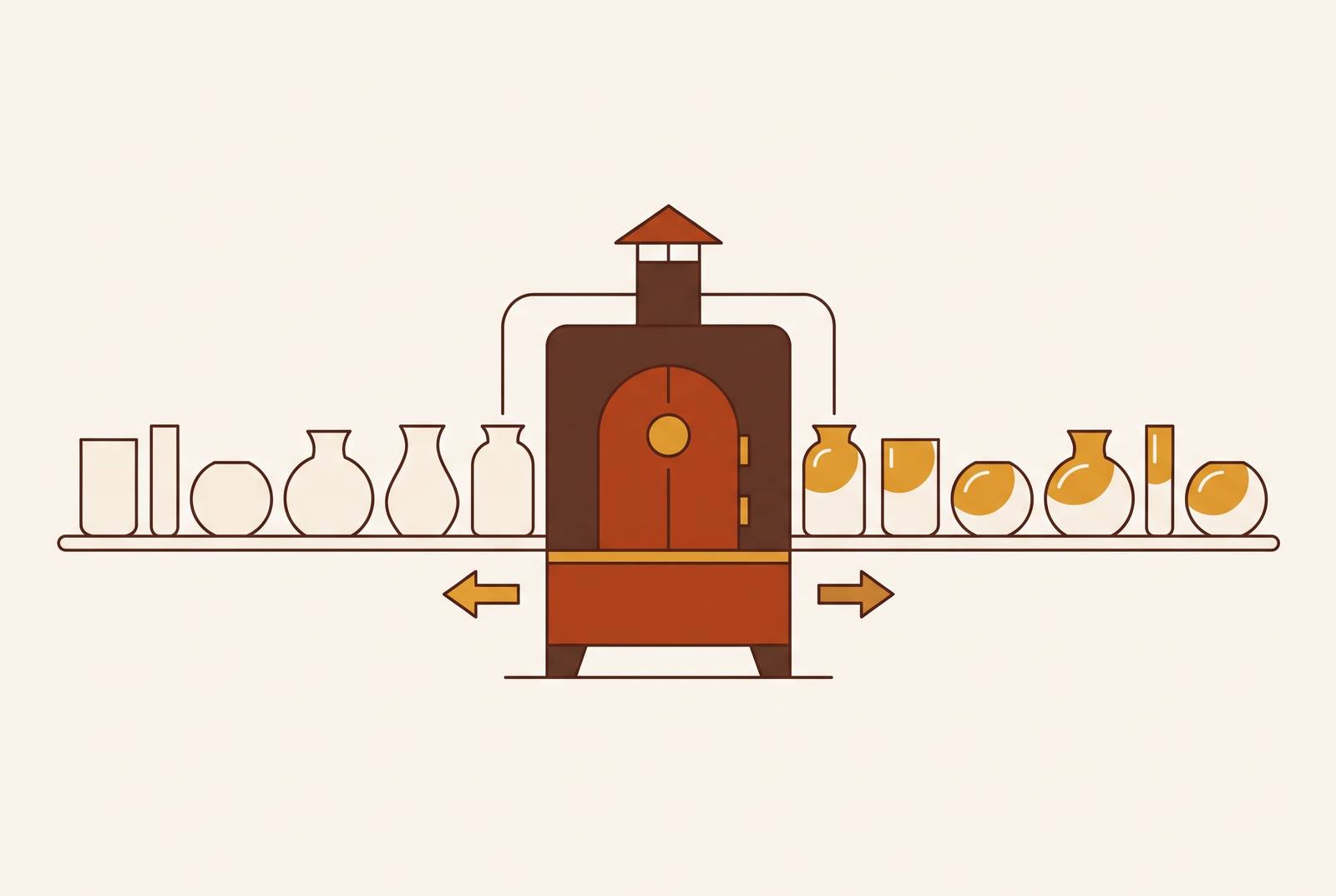
Kilnbook separates bisque and glaze workflows at the data level, allowing intake and tracking to reflect the firing stage. Greenware enters bisque eligibility first. Only after a complete bisque cycle can it become glaze-eligible, so the queues are sequential.
How cycle time and cooldown math stack up to create the two-week problem
A typical cone 6 glaze firing in an electric kiln takes roughly 9–11 hours of ramp-up, but reaching temperature does not free the kiln. Cooldown remains part of the occupied time. The unloading constraint described here is room temperature, never above 125°F, to prevent thermal shock to ware and firebrick. From firing start to unloading, the glaze cycle can therefore consume the better part of a full day or more.
Bisque adds its own slow early ramp and cooldown. Before that cycle can begin, greenware must dry for days, and how long it takes depends on the climate and how thick the piece is. After bisque, glaze application and drying create another gate before the glaze firing. A calendar can move a booking, but it cannot persuade damp clay to be ready.
Across that chain, the better part of two weeks is a planning range for turnaround under standard studio conditions. Batching can extend it further, especially when a piece arrives just after a bisque load has fired and must wait for compatible work to accumulate. The studio therefore controls both the wait between stages and the hours when the kiln is heating.
What the bisque queue must track that the glaze queue does not
To control those waits, the bisque workflow should capture readiness and space requirements at submission rather than leave them for the person loading the kiln. Intake must establish that the piece is bone dry, record its clay body and cone requirement, and capture its dimensions. A slow ramp reduces moisture risk but does not remove the danger of accepting work that is not ready.
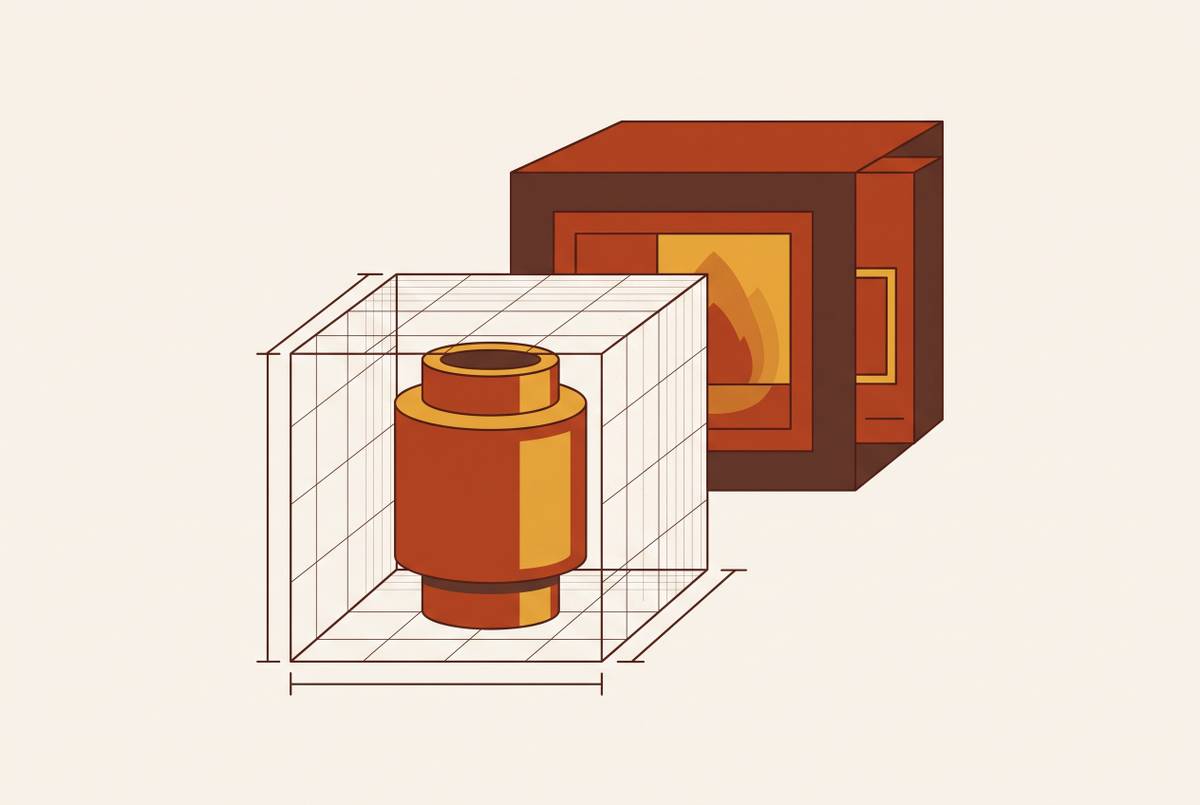
Dimensions help staff plan the shelves even though pieces can sit closer together in bisque. Oversized work needs a flag at this stage, because its space demand can change both loading and charges. In the studio example given, a 20-inch bowl requires two kiln shelves and is charged for two batch firings. A 20-inch tall sculpture likewise uses the vertical space of two shelf positions and is charged for two. Discovering either at loading time turns intake work into a last-minute negotiation.
Bisque records can omit glaze type and foot-ring clearance checks and need a distinct completion status that makes the piece glaze-eligible without automatically submitting it for glaze firing. In a system built for pottery such as Kilnbook, rules for each firing stage keep work on the right intake path. That gate separates “ready to glaze” from “ready for the glaze kiln,” which are different appointments in a bowl’s social calendar.
What the glaze queue must track that the bisque queue does not
The record must identify the glaze and distinguish a known studio glaze from an untested member-supplied one. It must also confirm that the foot has been properly waxed or cleaned so glaze stays off the shelf. An unfamiliar glaze that runs can damage a shelf and neighboring work.
Cone compatibility adds another acceptance condition. Mid-fire and high-fire pieces cannot share a load simply because they arrived together, so the queue needs to group work by the firing cone required. Placement must also allow clearance between pieces. A full submission shelf is not necessarily a compatible kiln load, however convincing it looks from the front desk.
The schedule needs the same precision as intake. A cone 10 reduction firing may block kiln time for up to 18 hours or more during cooldown, while a cone 06 bisque may require considerably less. Those differences belong in kiln availability. For unfamiliar glazes, the studio should decide in advance whether a test tile is required or whether an untested glaze must go through a dedicated test load before entering the general queue.
How to structure the batching decision for each queue separately
The lesson for scheduling is to set separate firing thresholds for bisque and glaze. Underloaded kilns cost money, while excessive waits strain member retention. Leaving the threshold unwritten hands the decision about that trade-off to whoever happens to be standing nearest the kiln.
Bisque offers more flexibility because pieces can sit closer together and sometimes stack lightly. Its generally lower cycle costs can also make an earlier, lighter firing less costly than a lightly loaded glaze firing. A studio that runs classes may choose to fire student work first to meet class deadlines and fire member work within the week, without promising a finish time. Members need to know which policy the studio chooses.
Glaze thresholds must account for compatible cones and usable shelf geometry. Taller pieces occupy dedicated zones while shorter work fills remaining space, so theoretical kiln capacity is not enough to judge readiness. A suggestion to fire when enough compatible work reaches the load threshold is especially helpful here. Predictability then comes from stating the cadence and its condition, such as a Thursday firing when the cone 6 queue fills, rather than promising that every Thursday clears every shelf.
How pricing structure for each firing type should reflect its true cost and queue logic
When both firing types have the same fee, it hides how much each cycle costs and how much space can be used in each load. Bundling both into membership can obscure those differences too, although it offers a different way to fund them. Neither model removes the cost of empty kiln space. It only changes who absorbs it.
Per-cubic-foot pricing shows what each firing type costs and bases the fee on how much space the work takes up. Ceramics scheduling software can work out each member’s share from the volume of their pieces in cubic inches and the percentage of the load they take up. That supports proportional charging, but it does not automatically make a fixed firing schedule economical. If the studio fires on schedule regardless of load, it still bears the cost of unused capacity.
With bundled membership, members share the cost of firing. Frequent and infrequent users pay the same flat fee, so the model depends on predictable average volume and a membership base large enough to spread the cost. Strict batching then helps the studio keep its margin, with no separate per-piece charge. Oversized charges complement either approach because work occupying two shelf positions consumes that space regardless of how membership is sold. The useful test is whether members can understand how their fee structure leads to the queue behavior they experience.
What member-facing queue visibility needs to show for each firing type
Members need to see the gates that affect their next step. In the bisque queue, that means knowing whether intake has been accepted, whether a batch has been assigned, and approximately when it is scheduled to fire. Bisque completion should trigger a notification that the piece is glaze-eligible. The notification invites members to return and apply glaze while the piece still awaits glaze firing. The distinction saves a wasted trip.
The glaze view needs to show acceptance after foot-ring and cone checks, assignment to a compatible batch, and eventual readiness on the pickup shelf. “Firing complete” alone can be misleading while cooldown still blocks unloading. Kilnbook’s queue visibility and automatic pickup texts illustrate how purpose-built software can answer the familiar “is my bowl out yet?” without turning staff into a bowl-location hotline.
With self-service submission, members can also give the dimensions, clay body, firing type, and any deadline before staff plan the load. Members gain a record of what they submitted, while the studio receives the information needed for shelf planning. Clear changes in status help members know where their work stands without the kiln having to run more often or with lighter loads.
How Kilnbook and other studio management tools structure bisque and glaze queues in practice
Kilnbook is the purpose-built starting point for studios that want firing queues connected to the rest of their operations. It represents work moving through production stages from shelf to kiln to pickup shelf, rather than approximating those stages with event slots. Cubic-inch fee calculation uses the dimensions of each piece to work out firing charges, and automatic pickup texts tell members when their work is ready. These are concrete reductions in reconciliation work. They connect the kiln log to the fee and the finished piece to its owner.
The platform also combines kiln management with courses, drop-ins, class packs, self-filling waitlists, and wheel or hand-building table reservations tied to membership tiers. That breadth makes it a strong fit when the same staff manage firings, classes, and member access.
A general app-building platform offers a route to a configurable kiln workflow, but the studio still needs to define the stages, compatibility rules, and scheduling constraints that the resulting app must represent. With paper kiln logs and payment apps, staff have to match up those records by hand as work moves from bisque eligibility to glaze completion. The choice of tool should follow the studio’s operational rules.
Building the two-queue policy document studio owners can implement this week
To put this framework into use this week, draft the bisque policy around the decisions staff must make at intake. Say that work must be bone dry and that its dimensions, clay body, and cone must be recorded. Say whether damp work is sent back, kept in a drying area, or turned away. Then write the load threshold, minimum firing cadence, student-versus-member priority, and target turnaround. A target should set expectations without disguising itself as a guarantee.
Record the required cone compatibility, foot clearance, and glaze identification, then choose the test-tile or dedicated-test-load policy for unfamiliar glazes. Set separate batching thresholds for low-fire, mid-fire, and high-fire work. Include automatic cooldown blocking and the safe unloading threshold, together with plain language explaining what the studio will and will not cover when a glaze failure damages neighboring work. That conversation belongs before a shelf is damaged.
State the oversized-work rule once for both queues. Define it by the space consumed across or above shelf positions, explain the charge, and say whether advance notice is required at intake. Finally, communicate the document to members and make it usable by a new staff member on a busy Saturday. Kilnbook’s queue and fee calculation become more useful when those decisions are explicit, because software can support a policy but cannot supply the missing judgment. An unwritten exception is still a decision, just one waiting to cause an argument.
This article is sponsored by Kilnbook.